
Menu Navigation

Services
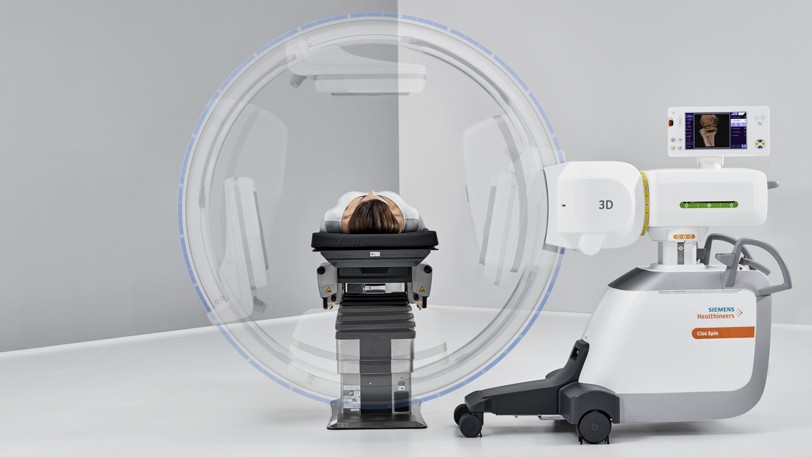
At ALTY Orthopaedic Hospital, we are committed to advancing surgical care through cutting-edge imaging and navigation technology. The Cios Spin is an advanced mobile 2D and 3D intraoperative imaging system that provides CT-like images directly in the operating theatre. When integrated with the Brainlab Navigation System, it enables highly accurate, image-guided surgery for complex orthopaedic and spine procedures.
This combination allows surgeons to visualise anatomy in real time, confirm implant placement during surgery, and improve precision, safety, and overall surgical outcomes.
The Cios Spin with Brainlab Navigation integration supports a wide range of orthopaedic and spine procedures by combining real-time imaging with advanced surgical guidance.
1. Spine Surgery
· Provides high-quality 3D imaging of the spine during surgery
· Supports accurate placement of pedicle screws and spinal implants
· Enables navigation-guided spinesurgery with real-time anatomical reference
· Assists in complex deformity correction and minimally invasive spine procedures
· Allows immediate verification of surgical accuracy before wound closure
2. Orthopaedic Trauma Surgery
· Assists in the management ofcomplex fractures and trauma cases
· Provides precise assessment of bone alignment and fixation
· Supports accurate placement ofplates, screws and fixation devices
· Helps confirm reduction quality intraoperatively
3. Joint & Extremity Surgery
· Supports procedures involving shoulder, elbow, wrist, hip, knee, ankle and foot
· Enhances accuracy of implantpositioning and alignment
· Improves visualisation of complex anatomical structures during surgery
4. Intraoperative 3D Imaging
· Generates CT-like 3D imagesdirectly in the operating room
· Allows surgeons to assessanatomy from multiple angles in real time
· Reduces dependence onpost-operative imaging for verification
5. BrainlabNavigation Integration
· Seamlessly integrates with Brainlab Navigation for image-guided surgery
· Combines real-time imaging with digital surgical navigation and planning tools
· Provides precise anatomical localisation during complex procedures
· Enhances accuracy in implant placement and surgical targeting
· Particularly useful in spine surgery, deformity correction, and revision cases
· Supports data-driven, highly controlled surgical execution

1. Greater Surgical Precision
· Real-time 3D imaging andnavigation improve surgical accuracy
· Supports optimal implant placement and alignment
2. Improved Patient Safety
· Enables immediate verification of surgical results during the procedure
· Reduces risk of implant misplacement and need for revision surgery
3. Better Surgical Outcomes
· Enhances correction of fractures, deformities and spinal conditions
· Supports improved long-term functional recovery
4. Advanced Image-Guided Surgery
· Combines intraoperative imaging and navigation for higher surgical confidence
· Helps surgeons make precise decisions in real time
5. Reduced Need for Repeat Procedures
· Allows intraoperative confirmation of surgical accuracy
· Minimises the likelihood of additional corrective surgery
1. Real-Time Surgical Decision Support
· Provides immediate imaging feedback to guide surgical decisions
2. Enhanced Accuracy in Complex Cases
· Particularly valuable in spine, trauma and revision surgeries
3. Improved Workflow Efficiency
· Reduces reliance onpost-operative imaging for verification
· Supports smoother surgical workflow and faster decision-making
4. Integrated Digital Surgical Ecosystem
· Combines imaging and navigation into a unified surgical platform
· Enhances precision, consistency and predictability of outcomes
In complex orthopaedic and spine surgery, precision is critical. Even small deviations in implant placement can affect long-term outcomes. Traditional imaging alone may not provide sufficient intraoperative feedback.
With the integration of Cios Spin and Brainlab Navigation, ALTYOrthopaedic Hospital delivers advanced image-guided surgery that allowssurgeons to see, plan and verify procedures in real time. This results in greater accuracy, improved safety and better patient outcomes.
· Patients undergoing spine surgery
· Individuals requiring complex fracture fixation or trauma surgery
· Patients undergoing deformity correction or revision surgery
· Individuals requiring precise implant placement and alignment
· Patients undergoing minimally invasive orthopaedic or spine procedures

